Data platform case study
Tolbi
Geospatial Yield Computation Service
Company
Tolbi
Role
Software Engineer
Duration
2022
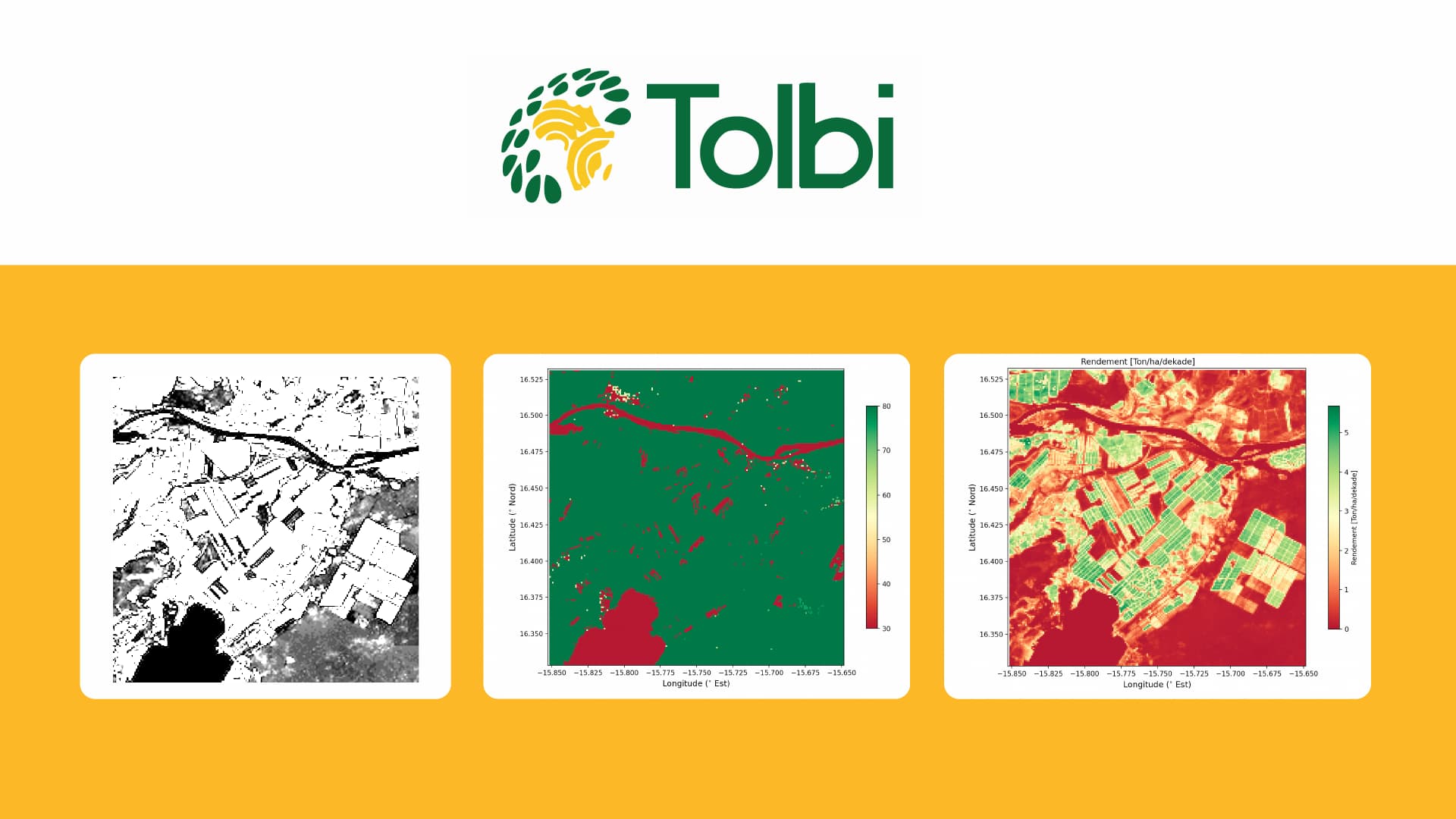
Designed and implemented a backend computation service that integrates satellite-derived productivity data with relational crop parameters to generate yield estimates for specified geographic zones and time windows. Built with a microservice mindset, emphasizing scalability, performance, and clean service boundaries.
Context
Remote data-driven monitoring at scale
The goal was to enable digital crop monitoring without relying exclusively on manual field data collection, which is costly and difficult to scale across regions.
Instead of building a static reporting tool, we developed a reusable yield computation service capable of integrating external satellite-based productivity signals into a broader analytics platform.
The system needed to provide reliable estimates, respond quickly to repeated requests, and remain extensible within a microservices ecosystem.
Problem
System-level challenges
- Integrate external geospatial satellite data into a structured backend computation pipeline.
- Combine remote sensing metrics with crop-specific parameters stored in a relational database.
- Ensure fast response times under repeated computation requests.
- Avoid redundant external data calls through intelligent caching.
- Maintain clean service boundaries aligned with microservices principles.
Contributions
Key engineering contributions
Backend Service & Data Integration
- Designed and implemented a Django-based computation service exposed through a structured API interface.
- Integrated remote sensing satellite data as an external productivity signal for yield estimation.
- Modeled a clear request → compute → response pipeline separating data retrieval, computation logic, and persistence layers.
- Structured the service to be reusable within a broader analytics platform.
Performance & Scalability
- Implemented Redis caching to minimize repeated satellite data fetches and reduce computation latency.
- Designed cache-first logic to improve throughput under frequent queries.
- Modeled crop parameter persistence using PostgreSQL with structured CRUD operations.
- Validated the pipeline through structured scenario testing with real-world inputs.
Architecture
High-level architecture
The service receives a yield request (crop, region, time range), checks Redis for cached results, fetches satellite productivity data when needed, retrieves crop parameters from PostgreSQL, computes the yield estimate, stores the result in cache, and returns the final response to the client.
Engineering approach
Design principles
Emphasized modular design, separating data access, business logic, and caching layers to maintain clarity and extensibility.
Designed the service with scalability in mind, ensuring that repeated queries could be served efficiently via cache rather than recomputation.
Focused on building a reusable computation engine rather than a one-off script, aligning with long-term platform evolution.
Impact
Platform outcomes
- Enabled remote, data-driven yield estimation without reliance on manual field collection.
- Improved performance and scalability through cache-layer optimization.
- Delivered a reusable computation service foundation for future predictive analytics.
- Demonstrated integration of external geospatial APIs into a production-oriented backend architecture.